

Dabbling in some neo-vintage discoveries
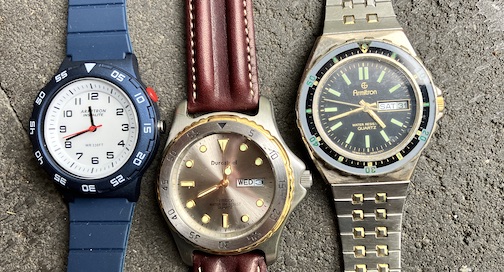
A reader got me thinking about a brand I had pretty much ignored up til now. In my activities of collecting, refurbishing(or having repaired), and writing about cheap watches, I have passed-over Armitron watches for one reason of another. This American company has been around forever, sort of in the background, mimicking all the more well-know brands.
It could have been because I had no personal experience with the brand’s watches. Maybe it was because the models I had noticed did not have any particular visual design elements that set them apart. Part of it could be that I related the brand to discount stores like the commodity Timex watches you bought like a pair of socks. My vague memories of them are that they were generic things with no soul of their own?
So, spurred by this reader who saw similarities between Armitron and some of my Eddie Bauer and Bulova examples, I started researching Armitron and looking harder at the used examples in the online market space. Being Lowly Caliber, I try to look at all lower-end watches objectively without regard to their status in current enthusiast circles. I like to look at the context in which they were created.
Dating watches in the low-end can be hard enough, but trying to figure out design criteria for older generic fashion watches is near impossible. One doesn’t see much old information about the ideas behind these watches. I can only guess at what the design/marketing/production teams at corporate HQ or in Hong Kong or China were thinking to come up with these designs.
The main idea in designing low-end watches is to look like something more expensive. Therefore, watch makers copy designs of more expensive, leading brands of the time. Original design is not as common as copying details or doing homage exercises. Even so, original design does happen in every company when smart observant marketing people see a potential and design and production people seek to exploit a process or material. The result could be something new? Still, the main idea behind Armitron was to produce cheap quartz watches in the 80s and 90s.
Why is This Watch Here?
I’m always fascinated when I look at any watch’s design details. Somebody made certain decisions at every point to end up with what is in my hand. Some things were more thought out than others. But if you consider dimensions, bezel, movement, hour markers, hands, dial case shape, bracelet, etc.; each thing has a reason for being there. Costs rule every decision. Some things are borrowed, some new, concessions are made. How do we know what was a successful design? If you design a watch for a specific task, that entails certain specifications. As a fashion accessory, the look might be the most important factor. The thing is with cheap watches is that you don’t do more than you have to. As I look at older Armitrons now, I seem to consider why they made what they did at the time.
What is Amitron?
Once I started looking harder at Amitron watches, I saw a wide variety of styles, and thought of Timex or Fossil in that they brand is trying to cover a wide variety of tastes. They are not only use specific, like say tool watches, or sports watches, or dress watches. There are lots of different types of Armitrons. Of course, all companies evolve over time and their objectives change.
You can buy new Armitron watches now, even though the company is struggling. They are available in quartz, smart watches, automatic. Online or in stores, but it is not a brand I shop for. I rarely buy any new watches, from any brand. I buy a lot of watches, but 95% are used or new old stock. The Armitrons I was thinking about and writing about are mostly 20 to 30 years old. But then, I’ve been looking at some newer ones, too. Off the cuff, I would say Armitron reminds me of current Fossil in that they make cheap fashion quartz watches in styles that don’t interest me and are usually too big, as in over 40mm. I generalize. I’m sure I could find something I like, but at first glance, the current designs are strange or too blingy.
While looking into Armitron, I saw on their web site they are selling new old stock watches under a Vintage category?! One was listed as from 1990 while others have no date? It would be interesting to find out what brought this idea about? Where did they come from? Most are sold out, but I just think it is a curious option.
(From Wikipedia) Founded in 1975 by Eugene Gluck, E. Gluck Corporation specialized in LED-powered, five-function (hour, minutes, second, day and date) digital watches. Armitron’s name came from combining Armin (parent company) and Electronics; Armi+tron= Armitron. The LED modules were produced in the U.S. and watch cases and bracelets came originally from Switzerland and Hong Kong. Sutton was brand they were selling and Andre Rivalle, which I knew from vintage skin divers. Armin and E. Gluck severed ties in 1979, but Gluck kept the Armitron name.
LED technology was replaced by LCD and Quartz technology. Low-cost Japanese quartz movements became the main source for most watch producers. However, with the early Armitrons, you will see some Swiss quartz movements. I think is is interesting to compare the early quartz movements, either Japanese or Swiss, to see how they changed from more metal and big open circuits to smaller contained in plastic units we see today.
Armitron really came into being as a result of the quartz revolution. It was the in the ’80s when cheap quartz movements became widely available, that E.Gluck/Armitron took off. From the 80s up into the early 2000s, E. Gluck was one of the biggest manufactures of quartz watches and was making licensed watches for many fashion brands. In 2019 E. Gluck acquired Torgoen who made pilot-style watches.
As with so many other low-end quartz watch producers like Fossil, E. Gluck has suffered from customers moving towards smart watches and/or higher-end mechanical watches. Also, many people simply got used to using a smart phone for time and don’t even consider a watch, of any kind, necessary. Things change. E. Gluck filed for Chapter 11 bankruptcy in Dec 2025. Fossil is pretty much in the same boat, but found a way to restructure their debt in Europe.
Here is a nice video by Illuminating Watches you will find interesting. It covers the Armitron history of digital watches.
Seek and Ye Shall Find
Of course, just as I become interested in Armitron as a brand, it’s parent company goes chapter 11. That is OK, since I am mainly interested in their older watches rather than their present or future offerings. As I scan the online markets for pre-owned Armitrons, I see lots of interesting watches.
Like I said earlier about their current website products, and as I did with MVMT and Nixon, when accepted for what they are, I can find some watches I like. MVMT has very few watches I would consider. Nixon has several new watches I like very much, but I have only bought older models.
I am drawn to the older Armitron watches, particularly the 80s and 90s. The problem is finding ones in good condition. Digital watches are not my thing, so I usually by-pass those. Ani-digi can be fun, so I will look at some of those. Mostly, as usual, I am attracted to the diver or field leaning styles, but any category of watch can catch my attention. There is no way to know what might intrigue me about a watch. I have wide-ranging interests. Amitron produced so many different styles of watches over the years that it is hard to pigeon-hole them on anything other than as entry level mass market.
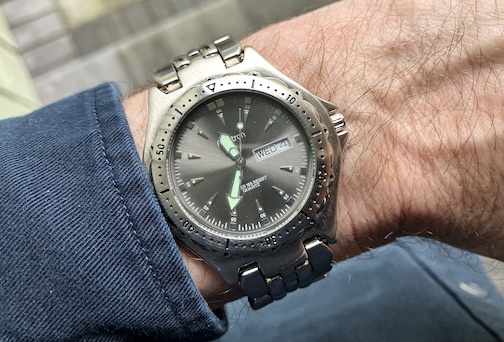
20/1297
I haven’t cracked the code on Armitron model numbers yet, especially for dating. The shape of this 20/1297 case is a familiar one. Very 90s and is like many of my Bulova Marine Stars. It was a safe place for me; 40mm, diver-ish, rotating bezel, grey sunburst dial, sloping crown guards, fat hands, pointy triangle hour markers. The 2105(3) on the case back should indicate the Miyota movement, which has been around a long time, so doesn’t help with dating. The 3 in parentheses I am no sure about?
This example was in great shape, but then, it might not be that old. I don’t know the date it was made. It just might not have been worn much? Late 90s to early 2000s? Its 40mmx48mm with those center lugs. Because of the 40mm size, I am dating in the 2000s. Its a good example of a cheap watch that looks better than it is.
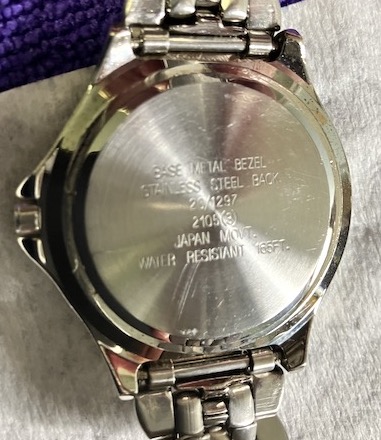
A nice looking watch, but it has its limitations. First of all the case is base metal and plated. Often a 90s base metal case will show plating rubbed off and corrosion. The 50m(165 ft) rating is not currently performing so. Its funny how cheap watches often used feet instead of meters; I’m not sure it was U.S. thing, or they wanted a bigger number on the watch? I was giving the watch a scrub with a toothbrush and lightly rinsing under the faucet and some moisture got in… Now that is expected of a 30mm watch, but normally a 50m watch can resist a light rinse under the faucet? It is a snap-on case back,and I don’t know the condition of the gasket.
The bezel is not easy to grip. As good as it looks, it slopes down on the edge so those wavy ridges are hard to catch. You have to exert a downward pressure to rotate the bezel, but, the 60-click action is pretty nice. Funny, I saw this same bezel while looking at an image of a Fossil Blue from the same time period.
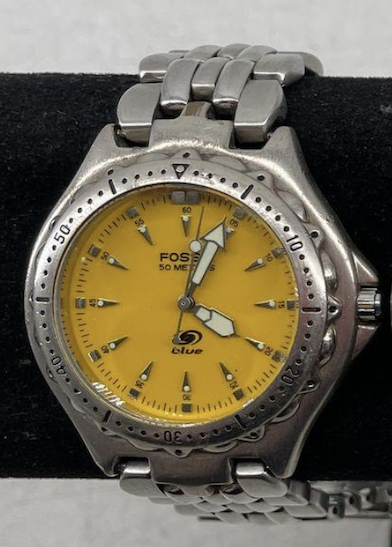
If you look at this Fossil above, the case, dial, crown, bezel and hands are the same as the Armitron. It is also 50m, but has a screw-on case back. It appears to have a better bracelet. This shows that competitors were using the same sources for components! I have also seen a 3-eye version of this watch with same case and bracelet.
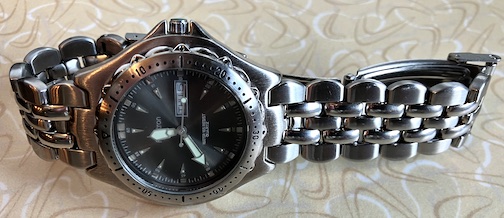
The bracelet can be a problem, too. With these three-prong lugs and integrated bracelet, you won’t be changing the bracelet for a strap! It is 20mm wide and does not taper, so the clasp seems quite wide. The links look solid but are folded. It is one of the weirdest bracelets I have ever seen. You don’t see the folds on the ends like the usual cheap folded link bracelet. The rounded side links are like a box structure.
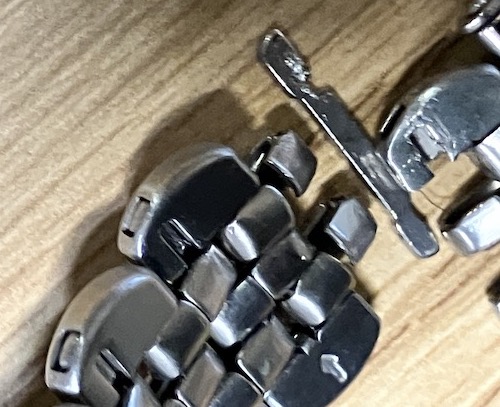
Removing links is difficult. It was one of the most difficult bracelets I can recall. The flat pin cannot be pushed through from opposite end. A standard folded link pliers tool does not work because the slot to get at the pin is so small, the lower half of the pliers does not fit. Then because the curve of the top/end of link, you can’t apply force perpendicular to the end and directly opposing the pin. Getting to the notch in the flat notched pin to force it up is difficult. It also takes a lot of force to get the pin started/detached, so the bracelet has to be secured. I had to put the bracelet in a vice with half the link out of the vice to clear the pin, so I could hammer a small screw driver or spring bar tool in the notch to get the pin moving! Is there such thing as an Armitron bracelet tool? This might explain why the watch was not worn much.
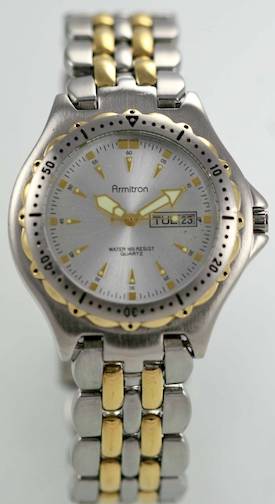
Of course, there is a two-tone version of the watch, that looks pretty good, too. There is a blue dial version also. This watch is a good example of a “cheap quartz watch” that you want to be better than it is. By the way, there were Ani-digi versions of this, too!
A Better Watch
Next up is a 20/1023, Durasteel, All Sport. That is a mouth full. The Durasteel line of Armitron watches have a stainless steel case instead of base metal, so a big improvement for durability/longevity. The WR rating is 100m, there is a screw-on back, and there is no three-lung integrated bracelet. Again, I’m left to guess on the date? Early 2000s?
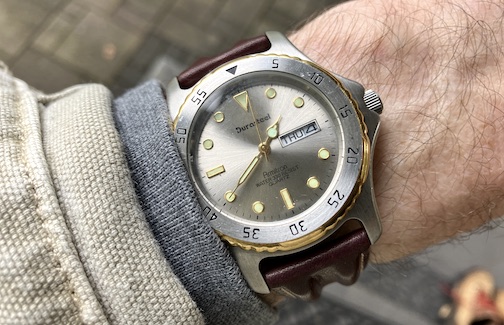
Size is 38mm x 47mm, lug width 20mm. I believe the watch originally came on a two-tone bracelet, but mine is on a Seiko water-proof leather 2-piece, pin-buckle strap. Its a little stiff, but doesn’t look half bad. I would like to try some rubber straps too. Some people don’t like the mismatch of the curves in the lugs and case against a flat end of a strap, but I like the versatility of straps. I’m not sure what became of the bracelet with the previous owner. With the two tone bracelet you get the full 90s experience, even though I don’t think it actually is a 90s watch. Like the watch before this, it seems to be a period of Armitron looking backwards for design inspiration.
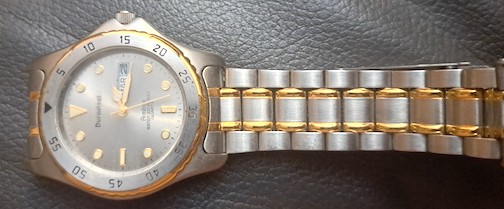
I like the looks of this watch. I like a two-tone, as well as this silver dial and silver bezel insert. It fits right in with the looks of many of my Marine Stars. It has a mix of vintage and modern details. The hand set is a modified Mercedes style. The gold plated textured bezel ring slopes like the previous 20/1207, unfortunately, but, seems to be a little bit easier to grip. It is cheaper to cast a bezel ring than machine one. I would say the bezel ring is cast base metal and plated then a stainless bezel insert is added. Again, more for looks than function. These are the decisions that separate a cheap watch from a not-so-cheap watch.
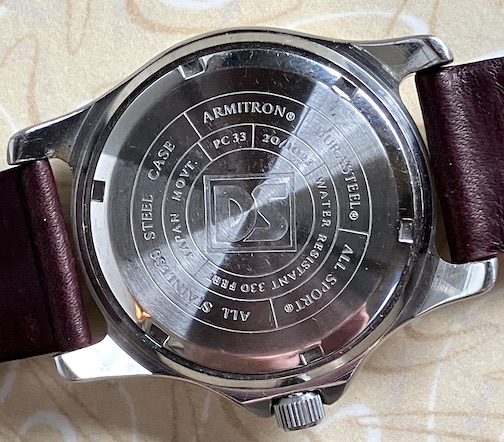
You can see from the back, the all stainless case and case back. This circular type layout with sectors is common with the Durasteel line. It gives a lot of info including model number, 20/1023 and movement number PC33, which is a Seiko/Hattori made, affordable quartz movement. The leap from a base metal case to a stainless case really changes the character of a watch.
I have a very similar looking watch made by Quintel for Eddie Bauer, with a cream dial, similar look, day/date, similar bezel and insert, that is a bit older and has a base metal case. But, it goes to show that common visual traits were shared across brands and how these cues get retained in the back of your mind when you see a watch. You see a watch for the first time and it reminds you of something you have liked before?
Change of Direction
Now for something completely different. This next watch, a 25/6443, Pro Sports line, has an acrylic case, stainless case back and silicone strap. It reminds me of the 90s era of generic sports watches that Timex, Casio, Swatch and others developed to cover any outdoor activity to be rugged, weather and water proof and have a light-up feature. Armitron called it Instalite.
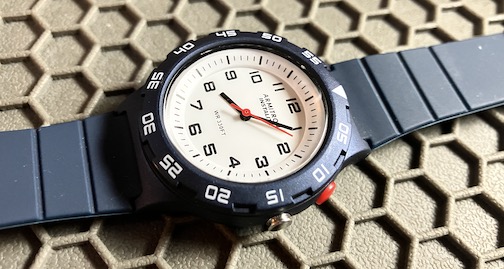
What is cool about this one, besides being almost new, is that it is navy blue, not black! The plain white, field-watch-like dial is so simple it is refreshing. There is depth to the dial too, with a large rehaut that carries the hour and minute hash marks. Overall its an attractive, refined design.
I don’t know what year it was made, but I’d guess probably between 2005-2020? The silicone strap is fairly recent for mainstream watches? The plastic, unidirectional bezel has a pretty solid action and turns easily. It is a 100m rated watch with that pressed stainless steel back held on by four screws. The plastic case measures 36mm x 42mm. The type on the case back is so tiny, its hard to read without a lot of magnification. It indicates the movement is a Y121F, an Epson product. Epson is an independent company under the Seiko group.
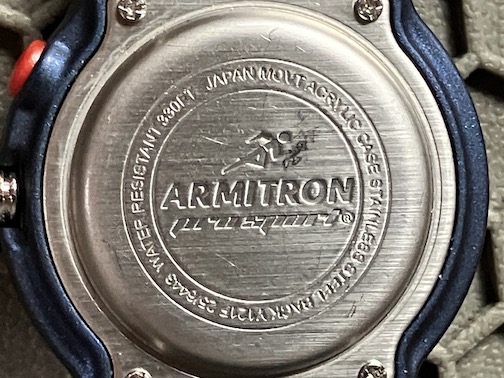
The acrylic case and bezel have a metalflake sparkle. You can see the mold line clearly running the length of the case side, from lug to lug. This really emphasizes the price point you are at with this watch as well as the material processes. A red button at 2 o’clock clearly indicates the Instalite switch. The unusual small stainless crown is one weak point. It has two grooves around its radius that assist getting your fingernails to pull it out. However, since there are no typical parallel grooves or knurling, its hard to get traction to turn the small crown!
Another small gripe I have is the hands. The minimalist black stick hands and red second hands and numbers are generally easy to read, but both are on the short side and the hour hand is just marginally wider than the minute hand. I wish they were differentiated more. A couple of time I have glanced at the watch at an angle and had to linger to distinguish the hour hand.
Back in Time
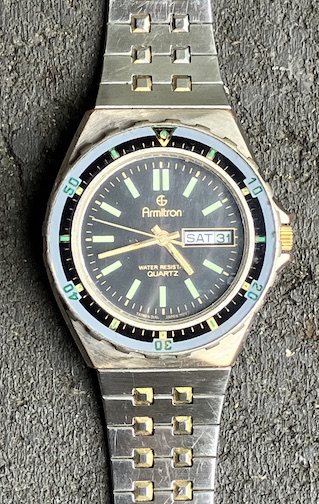
I do have a taste for the interesting, more what I call funky side of things. The ’80s and 90s had some distinctive styling at times. For some reason I was driven to get these two early Amitron quartz specimens with sleek tapered integrated bracelets. I’m assuming they are ’80s vintage but could be late ’70s. From the “older” logo on the 20/3375 which is an E. Gluck Trading Company logo, they could be late ’70s. Interestingly, I have a similar Gruen from the same time period.
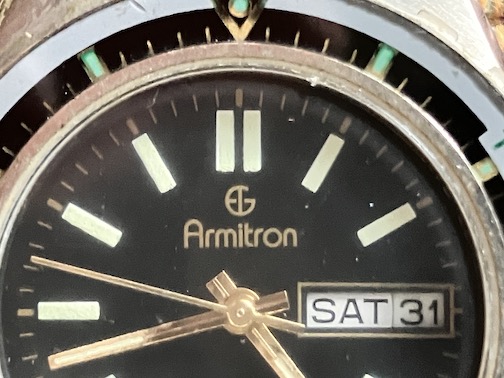
This 20/3375 was a wreck when I got it, but I was hoping a rescue could happen. It was very dirty and scratched up all over, and I knew it wasn’t running. After cleaning it up and doing some hand polishing it is at least is clean and has some shine.
It is a two tone, but most of the gold plating has been rubbed off. The base metal case has had plating worn off and there was some corrosion starting. Remarkably the crystal is pretty much scratch free. The case measures 36mm x 39mm, 9mm thick.
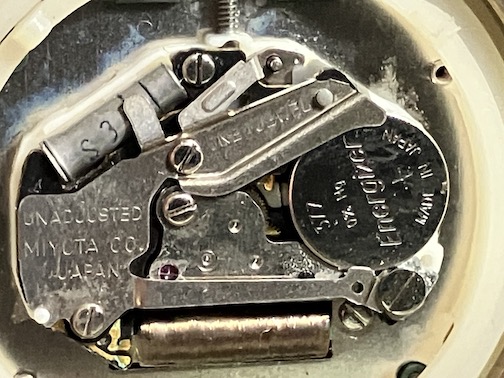
The old Miyota quartz movement is not working, so it will probably be getting replaced. I think it is a Miyota 2105-day/date with English/Spanish. It is a “one jewel” quartz movement, so very early for Miyota. As far as I know, Miyota was established in 1980-81 but making movements in the late ’70s. If I were to date the watch by the movement, I would say it was made in 1981 or after? I don’t have enough expertise to date it precisely.
I was drawn to this watch even in its bad condition. It is just so cool for several reasons; the strong dial layout with bold hour markers printed in a lume material. Gilt details all over the watch, a flat printed bezel insert covered by acrylic. The gold bezel ring of the friction fit bezel has knobby teeth that are easy to grip. The bracelet is great with its sliding adjustable snap clasp. It must have been quite impressive when new. You have to consider, too, this was early ’80s. Quartz was the new big thing. For the mass market, this would have been a pretty fancy purchase. It is only a 30m WR watch, but that was normal for watches of this type at the time.
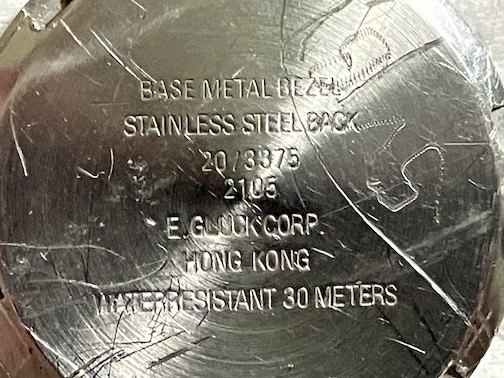
As you can see in the above image, the case back has been trashed. It seems several of the scratches are from attempts to remove it, probably for a battery change. It even has the intitals SVB crudely inscribed on it! The Armitron model number is there: 20/3375 with the slash separating the first two digits. What is unusual is that E.Gluck Corp. is on the outside of the case back as well as Hong Kong and the movement number! All that’s missing is the date! Unless the date is built into the model number?
This watch was made at a transitional time for E. Gluck, when they were moving from digital watches into more analog quartz. The shared E. Gluck branding would make way for Armitron only. This was still early times for mass production quartz watches. Hong Kong was the ticket for inexpensive bracelets, cases and assembly with Japanese movements.
I like these flat bracelets with sliding clasp closure. Besides the earlier mentioned Gruen, I have some 70s Timex and 80s Benrus, and Citizen with same type of bracelet. Timex brought it back for a while with the new Q in 2019.
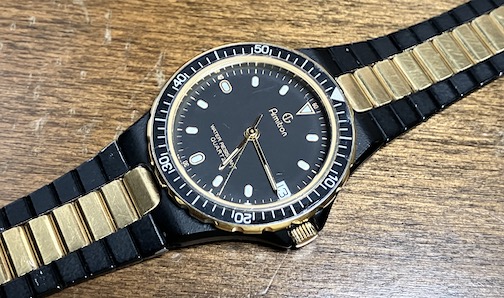
This next one, a 20/3379, has a similar layout with the flat integrated bracelet, but takes on the black PVD and gold look. Condition is better overall. The case is different in that the hooded lugs are gone but these lugs are uncommon, too. Its as if they were a hooded lug then a rounded window is cut out. It is smaller at 32mm x38mm, 8mm thick. It was probably in the women’s line. Even so, it has a unisex appeal with the black/gold and sport theme. If it was just a couple of millimeters bigger it could easily fit in the men’s line for the 80s-90s. The bracelet tapers from 19mm to 15mm.
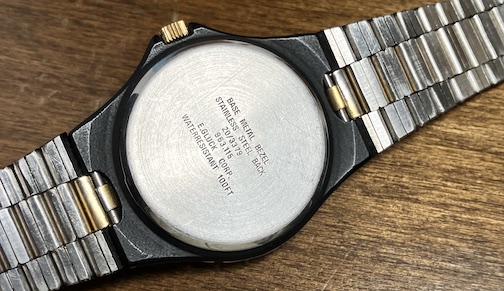
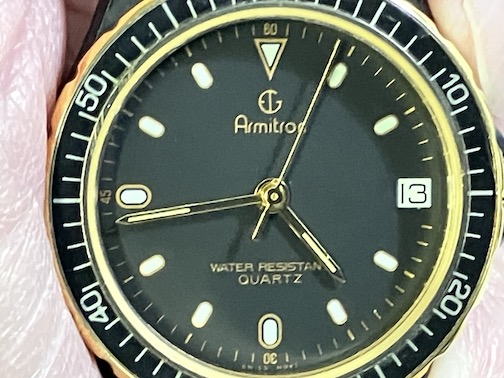
The design is more minimalist. Very stark in black and gold. More of an art piece, more jewelry than watch as tool. It has strong diver design cues with hour markers an rotating bezel, but is only a 30m WR watch. The three section links have a gold middle section that forms a stripe all the way down the bracelet. The dial is very simple; black with no busy tracks or hash marks. Just some gold type and the printed lume pill shaped hour markers. Of course, the lume is weak and does not last ling in the dark.The 12 is a gold outlined triangle and the 3,6, and 9 pills are also gold outlined. Date only, black numbers on white background. The thin aluminum black bezel insert has the numbers and hash marks in silver. All outlined with a shiny gold edge ring. It is a friction fit bezel.
Again, I’m not sure of the date, but this was a fairly early year in the E. Gluck/Armitron analog operation. The case and bracelet are Hong Kong made, the movement is Swiss. It is a ETA 963.115. That puts this watch in early to mid 80s. I have seen a similar dressy Bulova from 1986 with this movement. It’s working just fine.
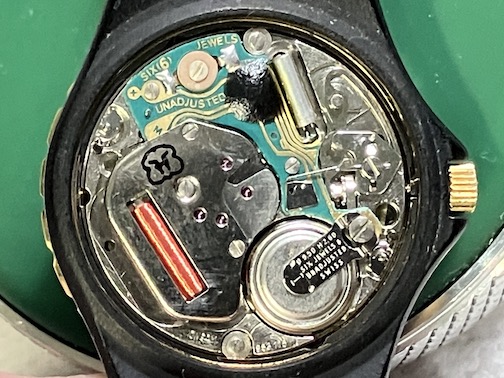
With these two watches, you get the feeling that they were of better quality in their time in the 80s than the first watch covered above from the 90s. Early quartz watches in the late 70s were new and quite expensive compared to mass market mechanical watches. A lot changed between the early 80s and the late 90s. One thing that had a big impact on the mass market watch was that the cost of quartz movements was able to come way down over time. It is great to compare how the old quartz movement look compared to the new ones.
A Little Wild
I’m not sure what to say about this next find? Outlandish? Theatrical? Imposter? It is the 38mm 20/2573, from year unknown. Another 30m (100ft) WR watch that looks like a diver. It offers a double false front; Not only is it barely a water resistant watch but that elaborate bezel does not even rotate! Still, I love it!
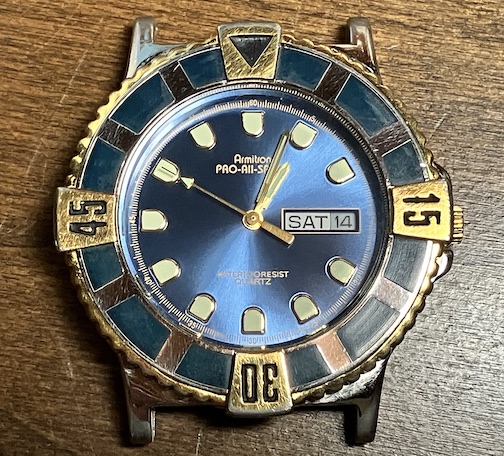
When I first saw this watch online, I immediately liked it. Looking at that bezel I assumed it would rotate. Even when I knew it didn’t, I couldn’t resist. It’s just so crazy. What could have possessed this design/marketing team to make this watch? Beyond the lack of water resistance and non-rotating bezel, they had the nerve to call it Pro-All-Sport?! This Armitron logotype is the the second version, I think. The first without E.Gluck mark–just Armitron.
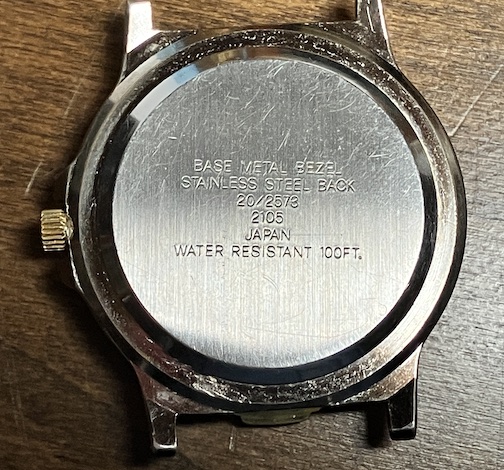
I’m guessing this early 90s watch was meant as a pure fashion watch with overt diver looks. On back the E. Gluck is gone but the model and movement are still listed. Another Miyota 2105 day/date watch. It has base metal plated construction, with standard stainless case back that snaps on. It came on a leather strap originally, which is fitting for a 30m WR watch, but, I think with those diver looks, it really should be on rubber? The patina and softness of the original brown strap is appealing.
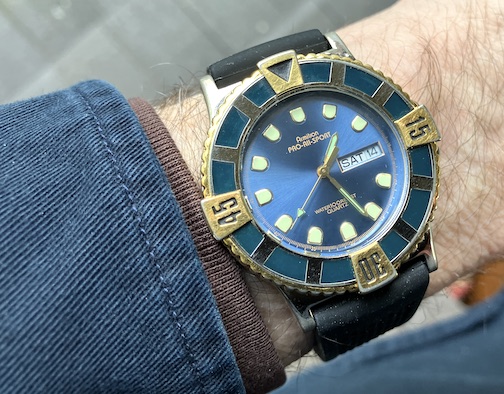
As I said, I don’t know where this idea came from, but putting in context, in the 90s, with cheap quartz movements available and tons of fashion brands pumping out these that are essentially jewelry that can tell you the time. The anti-watch watch? Its like a caricature of a dive watch. Its costume jewelry. The irony is that if this bezel had some increments and count-down numbers and rotated and the watch was a 100m WR and the lume better, it would probably sell well today? If it was built, like say, the Allsteel above, with some readable info on the dial and bezel, just sayin’…
The blue sunburst dial, the gilt, the cool hour markers, are great looking. The lume is weak, of course. There is a microscopic minute/sec track around the perimeter of the dial that is barely noticeable with the naked eye! The minute is a guess. I should mention, too, that the dial and markers used are just like those on a contemporary Gruen I have written about. Unfortunately, that Gruen bezel was very strange. The Armitron bezel with the alternating teal blue and silver segments is much better , even if maybe too dramatic. I have a Bulova Marine Star from 1991 that has a similar banded bezel insert. It is a 100m watch with functioning bezel, but still is not really a diver as much as a sporty dress watch? It lacks the crazy exaggerated Breitling-esqe tabs that this has.
1990s Quartz Pocket Watches
As I started researching Armitron wrist watch listings and articles, I ran across pocket watches too. Instead of ignoring them outright, I decided to consider the concept of the pocket watch in the last 30 or 40 years. Considering that Armitron didn’t come about until the late 70s and early 80s, their pocket watches were mostly going to be quartz. Also, in my limited experiences with pocket watches, they have all been mechanical.
If you look in the Timex catalogs from 1980 to 1983 they offered hand wound pocket watches. Interestingly, not prior to 1980, then not again until 1995 when they offered a quartz pocket watch by Ingersoll. The 80s is also the decade when Timex pretty much quit mechanical watches in favor of digital and quartz analog.
Since Armitron was a competitor to Timex and other makers, across a broad spectrum of watch styles, I became interested in a few Armitron quartz pocket watches. What was the interest in quartz pocket watches in the 90s? I was unaware of the trend of interest in pocket watches in the later 90s. I was not even really deeply interested in wrist watches watches, let alone pocket watches. Part of it was my age. A younger generation took a fancy to chained wallets and watches in the 90s.
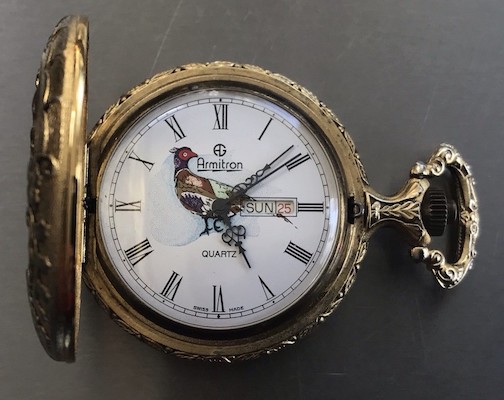
The above 80s Armitron quartz pocket watch has antique “hunter” looks with closing decorated case, roman numerals, elaborate hands but modern day/date (way inboard) and 3 o’clock crown.
As I looked into these Armitron quartz pocket watches I noticed how Fossil and Swiss Army/Wenger, Colibri, even Seiko, Bulova and others were producing pocket watches of all kinds. There were also carabiner watches and leather Bund-like carriers, all sorts of clip-on watches. Here again this shows how the cheap quartz movement allowed for a revolution of pocket watch designs that changed the concept of what a pocket watch could be. The watch could be lighter and cheaper, and thinner without the mechanical components inside.
What is funny to me is how many of the 80s-90s quartz pocket watches tended to be classic or antique designs! Its as if people wanted the nostalgia of the classic 19th century pocket watch but with the maintenance-free quartz movement and price. There were a few modern, contemporary or tool-ish designs, but as I look at listings many look like Breguets or railroad watches. Quartz pocket watches were also used as a vehicle for cheap promotional merchandise – just like their quartz wrist cousins.
I have never really considered pocket watches as something I would use. When I think about them now I wonder how i would mostly wear them? Shirt pocket, As I look over the listings of preowned pocket watches covering the last 30 or 40 years, mostly quartz, there are what I consider interesting watches among a lot of junk. But that is what I write about–watches that are not among the best made, highest quality watches. The cheap watches. Like the wrist watches I enjoy, there are designs among all the pocket watches that appeal to me. I have read a few articles from the past couple of years that say pocket watches are making a small comeback as people look to vintage. I think, however, like wrist watches, interest will be in mechanical, not quartz.
With pocket watches, one has to consider a whole other mode of using a watch, so that is another barrier. If you are a pocket watch user, you have to adapt your clothing to facilitate a watch and chain, or have flexible way of adapting to the clothing you happen to be wearing. The size of the watch, the chain type, the connector type can vary, like a strap for your wrist will vary by need.
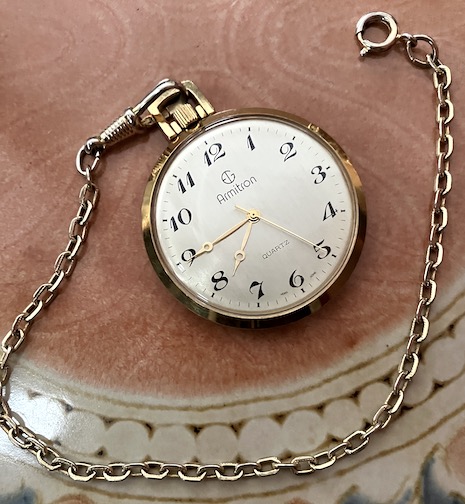
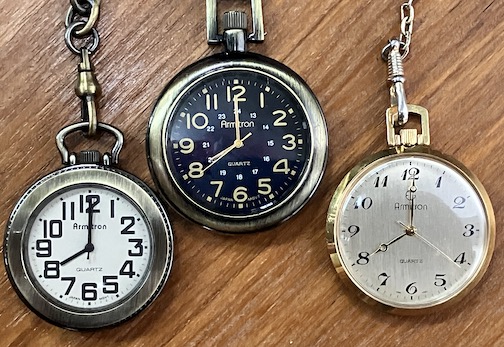
This 43mm (42.5) gold tone pocket watch pictured above, attracted me because of it’s simple classic looks. There seems to be several listings for this style. No cover, no decoration, gave it a more modern case outline, then it has Breguet style numbers and hands. The dial is gold tone, but comes off as silver in most light conditions. II have seen this style with a white dial and black hands. I had to find this lighter weight chain for it because the one it came with was silver and too chunky. Changing chains is like changing straps on a wrist watch. Its a slim, light, subtle watch, so really works with a light chain.
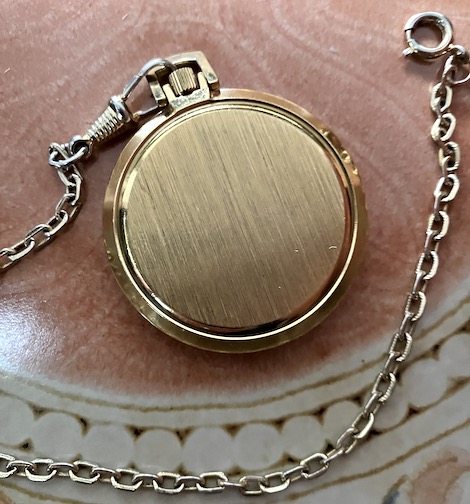
The plain brushed finish back is clear of any data and ready for inscription. It is interesting that the pocket watches don’t have the model number, and movement information on the backs that the wrist watches do. Nothing on the inside of case back either.
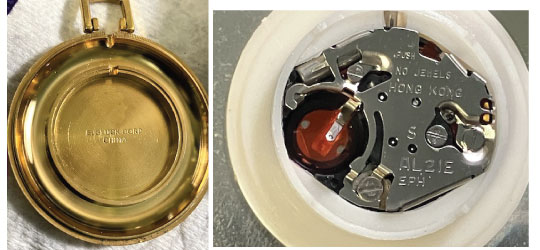
It does show E. Gluck Corp., CHINA, inside the case back, so we know the case was made in China. But, the dial read Hong Kong, which is unusual and refers to the movement, an Epson /Hattori AL21E, no date quartz movement. I have not seen many Hong Kong-made movements. I don’t have a model number for this watch?
Clip on
This next quartz pocket watch is just plain contemporary, basic 90s with antique bronzed finish. Maybe I should describe it as antique brass? I’m going to guess at about 1995? I like it because it reminds me of an old field watch dial with its inner 24 hr track and round end Mk1 numbers. Notice the changed logotype. This may be the third iteration? The logo and numbers are printed in a flat gold that sort of matches the case color. The inner 24-htr track is in white. The dial is essentially black, but in bright light it takes on a dark navy look. The plain stick hands are in plated polished gold.
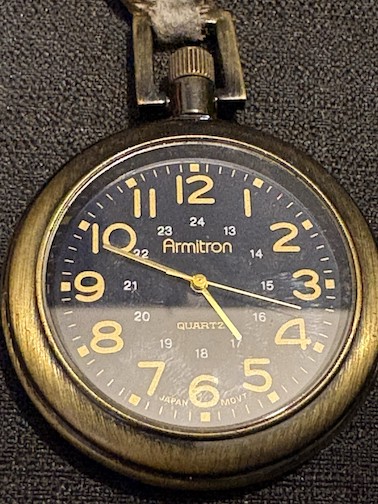
It came on a carabiner-like clip, but think it could be fine on a chain too. The clip has the same bronze finish and attached to the watch with a leather tab. Its got casual, a bit funky, personality. Definitely not a classic pocket watch look. The back is plain utility for bumping up against what ever it is clipped to. Its all about the front.
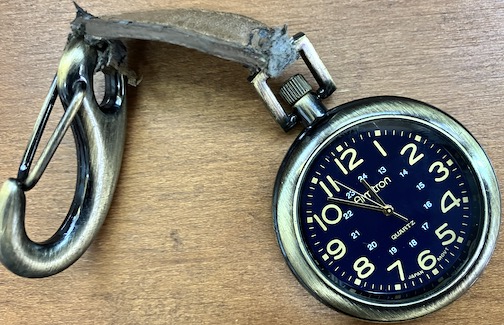
The clip-on watch seems to be a trend that has passed for the most part, but Dakota seems to be one company still in the game. I have collected a few older clip watches over the years because I do find the concept interesting. Frankly, it still seems like a viable idea to have wrist watches with quick-release straps that could be moved to a clip on holder with quick-release tabs for cases where you don’t or can’t wear a watch on your wrist? On this watch, the faux leather tab between watch and clip is going to have to be replaced since it is disintegrating on both ends. It is actually sewn onto the watch and clip, so it will have to be cut off. This presents an interesting problem; what to replace it with?
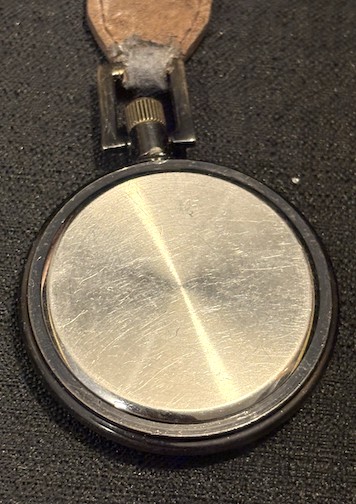
It measures 46mm across and about 9.5mm thick. So, it is slightly larger than the above gold pocket watch. I could see wearing this watch as a front pants pocket watch using the substantial clip to hook on a belt loop once I figure out what to replace the leather tab with. It could also just be put on another chain.
What I like about this watch is that it departs from the typical classic pocket watch look. The bold antique brass finish on watch and clip is something that would probably not be done on a wrist watch? With a finish like this, you know it is not trying to be pretentious–just fun fashion.
Almost Railroad
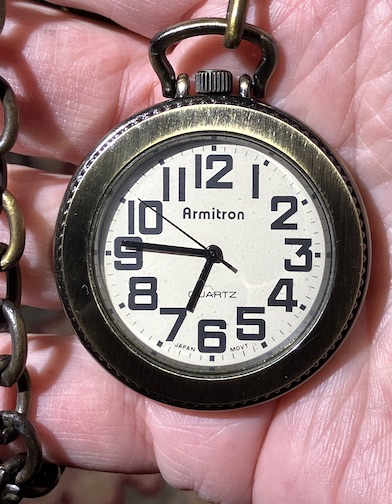
This last Armitron quartz pocket has a similar yet smaller case build to the last one, but presents a different bold look. It surprised me once I had it in-hand. It has a cream dial and classic “railroad” watch number style. Besides the bold numbers, I was attracted to the case finish which, from online image, looked like an antique silver or pewter. When I got it I could see that is was, again, an antique brass color. It needed a good cleaning. I’m quite alright with these faux finishes. After all, in the inexpensive fashion segment of watches this is about fun–cosplay if you will. I’m going to date this one a little later than the previous dark dial/brass style. Maybe 2000-05? The Armitron logotype is slightly changed again showing flatter ends and small serifs as well as more space between characters.
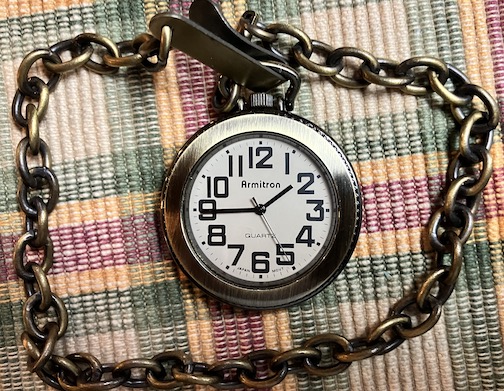
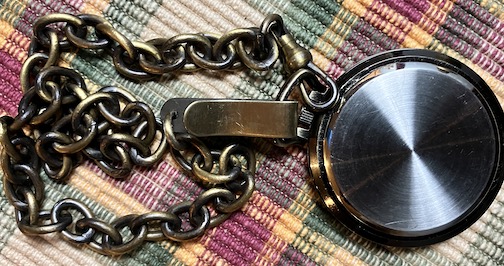
Part of the projected image here is of a robust, working watch, with emphasis on the chain with belt clip. When it arrived, it was smaller than it looked; only a 42mm. If you have looked for watches of this type you will notice sellers often don’t list sizes. I think this is because many of these pocket watches are bought as novelties or gifts by and for people who are not necessarily watch enthusiasts. This again being a light weight quartz watch, the proportionally big and long chain, at first seems excessive. I’m pretty sure this is the original chain. Of course, it depends on your personal preference. If you want a lot of attitude and to emphasize the chain, go for it. I thought of Jacob Marley’s ghost in Dickens’s A Christmas Carol when I saw this chain. I do like the chain and finish, but it just seems a bit big(8.5mm) for the watch? I’ll see if I can search out a similar finish on a finer chain.
The flat brushed bezel gives it a sturdy look even though it is a small watch. A beaded decoration around the bezel and a wide, curved bow are more classic pocket watch details. The white and black dial and stick hands are all business. The hand shapes look similar to those on the bronze model above. The numbers are so bold they practically run into each other. Still, it remains very simple. It reminds me of many Gotham railway style pocket watches but is simplified by not having the numbered minutes scale on the perimeter. I do really like those Gotham dials. I think this Armitron dial would be more interesting if it had some more of those details. (I also think it would have to be a bigger watch, with a bigger dial to add these details.) It comes across as “railway lite”, making it more casual rather than a tool for accuracy.
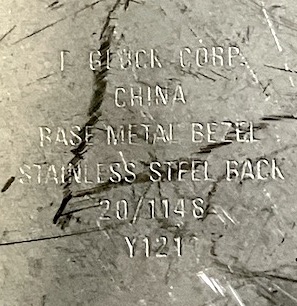
Inside the case back was the same type of data found on the backs of Armitron wrist watches. E. Gluck again, CHINA, as well as model number and movement. In this case it is a Y121E made by TMI Japan.
Final Thoughts
With so many years and models of Armitons out there, I didn’t really know what I was going to do with this post. There could be more posts to come with this brand. I gravitated to the older watches because they had more character and historic significance being earlier in the quartz boom. I could have covered many more from the 80s and 90s. I have not been too interested in many of the Armitron watches I’ve seen from the last 15 yrs or so. But then, I haven’t been looking either. As I mentioned earlier, looking at the current offering, there is not much to get excited about.
Looking at listings of old Armitrons for sale, I can say that the women’s offerings had some creative and unique stuff compared to Timex. I thought some of their Diver-style models looked interesting but lacked the specs. Along those lines, there are more Durasteel, 100m WR options that may be fun. You have to go in with the right mind set; this is mainly a fashion watch brand. I was surprised by the number of pocket watch options. If you are a digital watch fan in either LED or LCD, I’m sure you could find some great neo-vintage stuff.
I was really thrown off track by the pocket watches. It’s a segment of the watch world I have not really explored at all. Like other specific categories of watches, there are many price levels and sub groups as well as a new language of terms and history and culture. I stuck to small low-end quartz pocket watches from a narrow time frame. I could see myself exploring and posting on the pocket watch experience more in the future.
In the end I would like to see this American watch company stay in the fight. The watch market has changed much since Armitron was in their prime. Like Fossil, they have not found their way in the Apple watch/smart phone era. In the new enthusiast space, they will have to move up into higher price points a stiff competition. If they stay in the battle with Timex, Swatch, Casio, Caravelle and Fossil, they will have to differentiate themselves from the pack.
Leave a Reply